How running started by accident
Like many things in my life, running started by accident.
If you'd rather watch than read, here's the video version of this post (in Finnish):
Project 83.5
It was spring 2014. I did something rather foolish and hired a personal trainer on national No Diet Day, of all days. Under his supervision I began a six-month program, code-named Project 83.5.
Most of the program involved grunting in the gym, but to balance it out there was also easy recovery running. Having suffered various leg problems in my youth, I remember wondering whether running would be worth the pain. Or rather, whether I'd end up paying for it in pain.
As the project went on, however, I found I much preferred Helsinki's Central Park to the gym. And my knees didn't crack or my ankles give way the way I'd feared.
The shirt that gave it away
As the six-month project neared its end, I experienced a life-changing event. While tying my shoelaces, the shirt I was wearing split across the back.
That was when I realized I'd failed at my original goal, which was to go down a clothing size. Instead, I'd acquired shoulders and clothes one size larger.
Chasing pixels
Around New Year 2014-2015, smartwatches and self-tracking were becoming mainstream. The activity tracker I got for Christmas also changed the way I thought. I still remember the intoxicating feeling of seeing, for the first time, those little rows of activity pixels fill up on the screen.
The easiest way to fill every bar was, of course, to get around on foot as much as possible. Best of all, it was finally possible to do something genuinely at 110 percent.
They say that once a measure becomes a target, it stops being a good measure. I'd argue that in my case the opposite was more or less true. Chasing those bars, I accidentally ended up building something far more useful: the habit of going out for a run.
First my personal trainer made me run; then I was taking orders from an activity tracker. At some point, however, something even more worrying happened. I started running without anyone telling me to.
Stockholm Half Marathon
By autumn 2015, the condition had progressed so far that I signed up for the Stockholm Half Marathon. I completely underestimated the size of the event and barely made it to the start line in time.
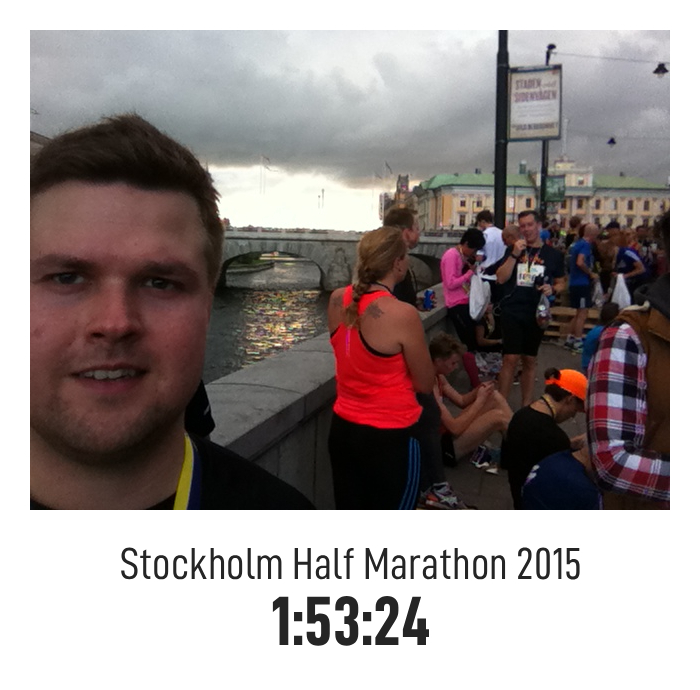
As soon as we got moving, I noticed my shoelaces were loose, so I had to stop within the very first kilometre. Apart from that opening chaos, I remember next to nothing about the race. Not even whether I drank anything along the way.
Part of what I like about running is precisely this temporary shutdown of higher brain function. On long runs, you can slip into a kind of runner's psychosis, or whatever they call that flow state. It works best on long straight stretches and familiar forest trails, where the outside world requires no attention whatsoever. But apparently it works in a big city too, as Stockholm demonstrated.
I finished comfortably under my two-hour target. What I've wondered about ever since is my average heart rate of 176. These days I only reach numbers like that in a finishing sprint, if even then. So, without realizing it, I'd spent a good part of the race firmly outside my comfort zone.
The most important thing I brought home from Stockholm wasn't on the clock or in the stats. It was the new hobby that had quietly crept into my life. In a year and a half, recovery exercise had turned into a situation where I traveled voluntarily to run around in circles, and even paid for the privilege.
By this point, the diagnosis was becoming pretty clear: I was a goal-oriented recreational athlete.